
In the previous post, we illuminated why standard runtimes like LM Studio and Ollama hit their limits with asynchronous agent swarms and how H.U.G.I.N.N. decouples inference requests via the Thalamus EventBus.
However, the most elegant software-level decoupling is useless if the physical hardware capitulates: How do you run specialized vision, cognition, and coding models on a local workstation with standard 16 GB of VRAM without the system crashing due to Out-of-Memory (OOM)?
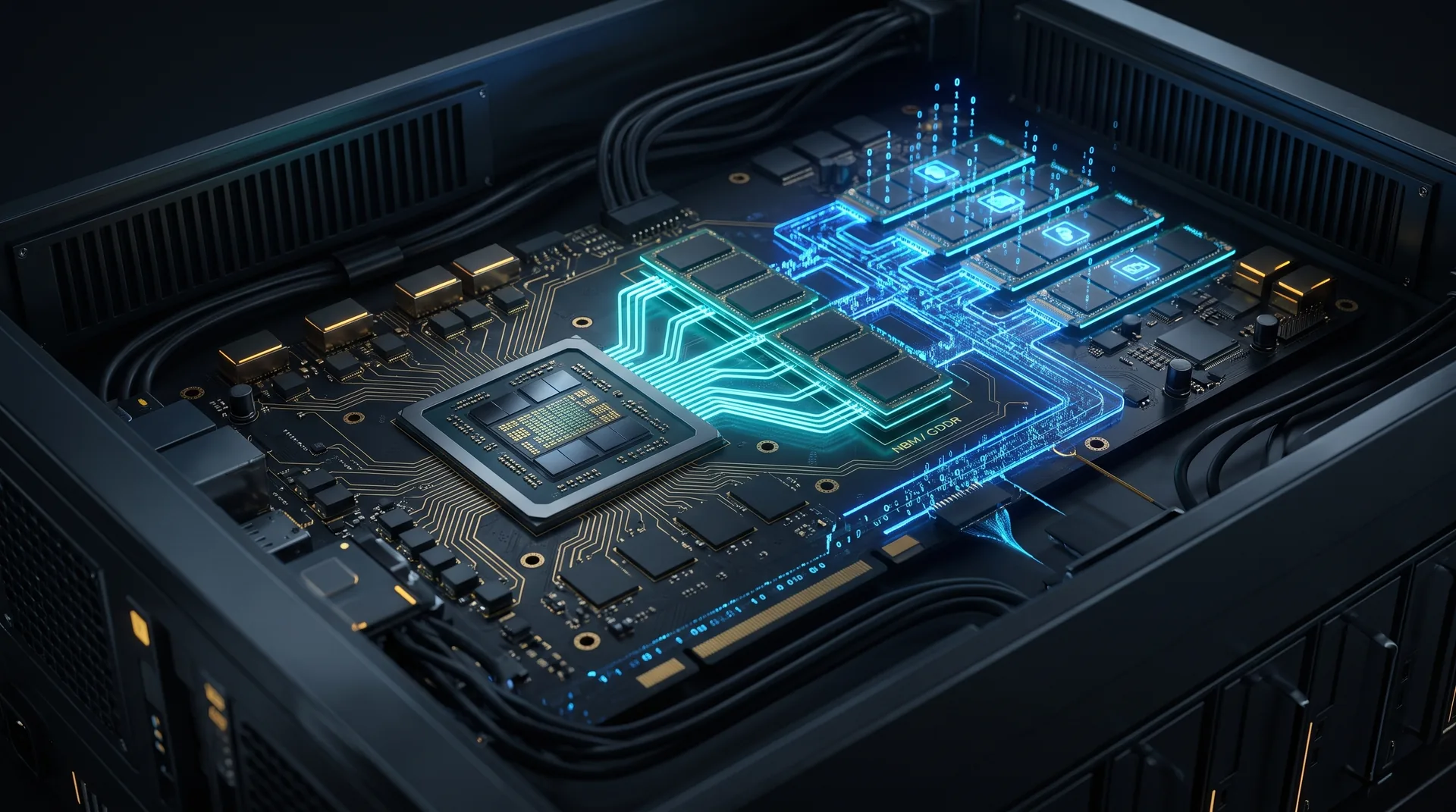
The answer is the core of our backend: the VGPU (Virtual GPU) and its three-stage Tiered-Memory Architecture.
The Dilemma: Fragmentation vs. I/O Collapse
In a multi-agent system, two opposing memory requirements arise: 1. Simultaneous Residency: If multiple quantized models are kept in VRAM in parallel, the address space fragments. There is no buffer left for the dynamically growing KV-Cache of long contexts—the driver reports the service with an OOM crash. 2. Naive Model Switching: If models are completely reloaded from the disk upon every task switch, the inference rate collapses. Even fast NVMe drives introduce noticeable latency when fully initializing 8 to 14 GB GGUF tensors.
To resolve this conflict, H.U.G.I.N.N. no longer treats the GPU as isolated, single-instance memory but spans a virtual memory pool across three hierarchical layers.
The 3-Stage Tiered-Memory Hierarchy
Instead of an all-or-nothing approach, the VGPU dynamically manages tensor blocks and state caches across bus and memory barriers:
┌────────┐
 │ TIER 0: GPU VRAM (16 GB) - Hot Execution Layer │
 │ • Active Inference Core & dynamic KV Cache │
 │ • Highest Bandwidth (e.g., GDDR6 / GDDR6X) │
 └─────────┬──────────────┘
 ▼ (Zero-Copy Transfer / Host-Offload)
 ┌────────┐
 │ TIER 1: System RAM (Host DDR) - Warm Standby │
 │ • Resident parked layers of inactive model instances │
 │ • Fast layer swapping without disk I/O │
 └─────────┬──────────────┘
 ▼ (Kernel-Level Zero-Latency Paging)
 ┌────────┐
 │ TIER 2: NVMe SSD - Cold Model Vault via OS-mmap │
 │ • GGUF Tensors directly in the virtual address space │
 │ • Block-wise loading via Kernel Page Faults │
 └────────┘
1. Tier 0: Physical VRAM (Hot Layer)
The GPU memory is exclusively dedicated to the executing graph during token generation. Only the immediately computed weights and the growing KV cache reside here. This guarantees maximum memory bandwidth without thermal or bus throttling.
2. Tier 1: Host System RAM (Warm Standby)
If a model is not temporarily needed for generation, it is not discarded. The vGPU transfers inactive layers over the PCIe bus into the system memory (e.g., 64 GB DDR5). Due to pre-prepared Direct Memory Mappings, these layers are ready in fractions of a millisecond for the next request—completely bypassing a cold start from the SSD.
3. Tier 2: NVMe Memory-Mapping (mmap)
All quantized models reside in our internal Vault. Instead of sequentially reading model files into RAM, H.U.G.I.N.N. maps the GGUF tensors via kernel-level mmap. The operating system maps the file directly into the virtual address space. The system only reads the exact pages from the NVMe that are referenced during computation—unused weights never burden the physical memory.
The Physical Cost: The PCIe Bottleneck
Every memory virtualization is subject to the laws of physics. Anyone who claims to be able to move a model arbitrarily between the GPU, RAM, and NVMe without sacrificing speed is ignoring the reality of bandwidth:
- GPU VRAM (GDDR6/GDDR6X): Delivers 500 to 1,000 GB/s of bandwidth. The compute cores are supplied with tensor data at full speed.
- PCIe 4.0 / 5.0 x16: Limits throughput to a net approximately 31.5 to 63 GB/s.
- System DDR-RAM: Typically provides 50 to 80 GB/s in dual-channel operation.
Once a model is larger than the physically available 16 GB of VRAM (e.g., with heavily quantized 27B or 70B models) and layers must be processed from system RAM across the PCIe bus, the bottleneck shifts: It is no longer the tensor cores limiting the speed, but the bus throughput.
In practice, the generation speed drops from previously 35–50 Tokens/s to 3 to 8 Tokens/s with heavy CPU/RAM offloading.
Why the Trade-off Still Pays Off in L.U.N.A.
In an interactive chat application, such a drop would be frustrating. However, in an asynchronous multi-agent architecture like L.U.N.A., it is a crucial strategic advantage:
- Availability Trumps Total Crash: If Agent Prof. Simon needs to perform a deep semantic analysis or a code audit, a stable run at 5 tokens/s is infinitely more valuable than a system crash due to Out-of-Memory.
- Decoupling via Thalamus: Since agents pass inferences to the EventBus via tickets, a large, offloaded model does not block the rest of the organism. Lightweight agents (e.g., based on 4B or 9B) fire completely in the fast VRAM, while heavy background audits are processed asynchronously in Tier 1.
- Autonomous Return to Peak Performance: As soon as the heavy task is completed, the VRAM lease manager deterministically releases the resources. Subsequent processes immediately regain the full GDDR bandwidth.
Conclusion: Determinism on Standard Hardware
H.U.G.I.N.N. proves that advanced multi-agent research does not have to be tethered to server clusters with six-figure budgets. Anyone who accepts the physical limits of the PCIe bus and masters the memory hierarchy spanning VRAM, Host-DDR, and NVMe-mmap transforms a regular 16-GB workstation into a reliable cognitive control center.