
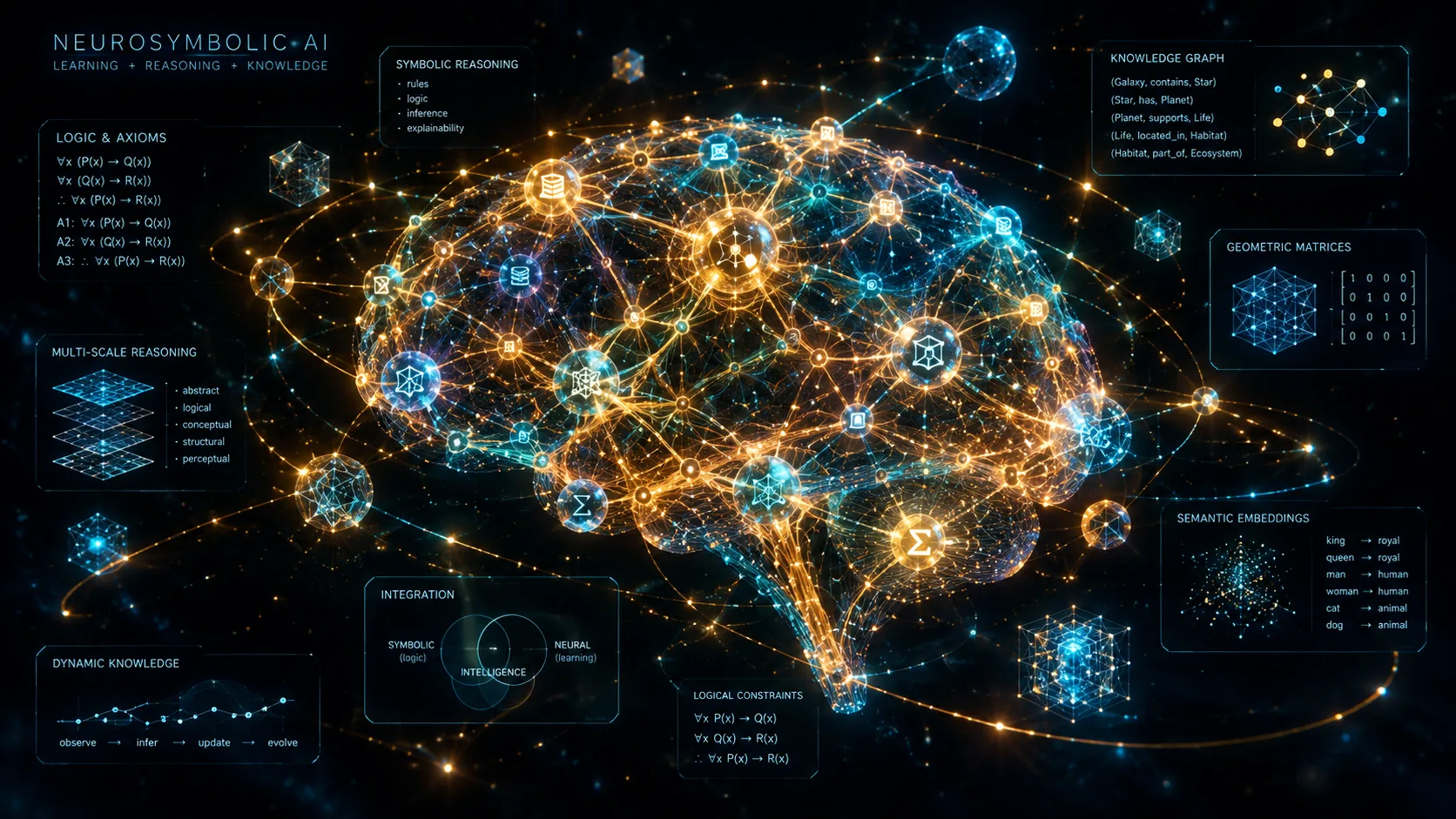
Beyond Language Models: How L.U.N.A. Learns to Think Through Neurosymbolic AI
In the current discourse surrounding Artificial Intelligence, the dogma is almost unquestionable: More computational power, larger models, even more parameters. However, anyone developing autonomous systems will eventually hit a fundamental limit. A Large Language Model (LLM)—whether a gigantic cloud service or a highly optimized local model—is not a thinking apparatus. It is a statistical text generator. It predicts which word should follow next based on probabilities.
For creative dialogues, summarization, or stylistic phrasing, this is phenomenal. But for an autonomous system that needs to make well-founded decisions, verify code, or grasp scientific relationships, this stochastic guessing is a breaking point. It leads to the well-known problems: models hallucinate facts, confuse cause with effect, and consume considerable inference time even for trivial logical deductions.
For our autonomous AI ecosystem, L.U.N.A., we have therefore fundamentally reset the course: The gradual emancipation from the language model. Our goal is not to prompt an LLM ever more artfully—but to transform L.U.N.A. into a system that can act deterministically, traceably, and independently of stochastic inference.
The key to this is: Neurosymbolic Artificial Intelligence.
What Does Neurosymbolic AI Mean?
Instead of burdening a language model with the entire thinking process, we strictly separate the tasks within the system according to cognitive capabilities:
-
The Neural Part (Perception & Language): Neural networks function like sensory organs. They are excellent at acquiring unstructured signals—spoken language, image data, or free-text queries—and deriving structured concepts from them or formulating understandable results.
-
The Symbolic Part (Thinking, Verification & Storage): The actual knowledge, logical deductions, consistency checks, and mathematical proofs reside in a symbolic, exact architecture. This is where computation occurs, not guesswork.
The language model sheds its role as an unreliable fact generator and is reduced to what it truly excels at: a linguistically eloquent translator for the underlying logical truth.
The Neural Network: From Data Storage to Relational Knowledge Graph
For a long time, data, like in most IT systems, resided in flat database tables: a collection of scientific theses, a corpus of processed technical literature, system metrics, and empirical values placed side-by-side. However, isolated tables cannot recognize relationships. A thesis on signal theory stood unrelated to a treatise on optical lens systems—even though both share the same mathematics.
To build genuine understanding, we have migrated these flat data stores into a directed, relational knowledge graph. One can imagine this as a deterministic, perfectly transparent neural network:
-
The Nodes (Knowledge Units): Each verified scientific finding, every formula, and every definition forms a fixed neuron within the system.
-
The Edges (Synapses): The nodes are wired together via exactly typed relations:
- Requirement (
REQUIRES): This A necessarily requires this B (e.g., Fourier Transform \rightarrow complex numbers). - Support (
SUPPORTS): A finding from mechanics empirically substantiates a relationship in materials science. - Refinement (
REFINES): A statement describes a precise exception or a special case of a general physical principle. - Exclusion / Contradiction (
CONTRADICTS): Two assumptions logically exclude each other.
Through this synaptic architecture, the system no longer requires a language model for logical connections. When a question is posed, the graph traverses along its edges and delivers the substantiated truth in fractions of a millisecond—with exactly zero token consumption and zero hallucination risk.
Ontological Sharpness: What is real, what is fictional?
A pure language model lacks an ontological understanding of the world. For a neural language network, a real satellite orbit, a mathematical impossibility, and a flying dragon are linguistically equivalent text units.
For a reliable instance, this ambiguity is untenable. L.U.N.A. learns through its category system to separate ontological levels with surgical precision:
-
Empirical Reality: What is currently incontrovertibly true according to the laws of nature and mathematical proof?
-
Technological Limits vs. Fiction: A car is a mechanical construction, not a biological organism. Unless, of course, one is deliberately designing a biomechanical biospecies within the context of a science fiction scenario. The system understands the categorical difference between “not yet technically feasible according to current standards,” “physically fundamentally impossible,” and “fictional worldbuilding.”
-
Logical Contradiction: What violates fundamental axioms and must be discarded?
The Immune System: Autonomous Self-Healing Without Circular Reasoning
A system that continuously ingests scientific literature from diverse fields is inevitably at risk of incorporating faulty or contradictory theses. If left unchecked, the memory itself becomes contaminated over time.
But who decides what is correct? If we were to use an LLM as the arbiter, we would have created a circular argument: a stochastic model judging whether a statement is stochastic nonsense.
L.U.N.A.'s immune system therefore operates strictly deterministically through three mechanisms:
-
Structural Polarity Check: Statements exist in clear relationships within the graph. When identical entities encounter polar opposites (e.g., “amplifies signal” vs. “dampens signal”), the relational graph logic immediately raises an alarm via semantic antonym matrices.
-
Formal & Mathematical Validation: In hard disciplines such as physics, circuit engineering, or computer science, theses are tested against functional test vectors, dimensional analyses, and mathematical limits. A physically impossible claim fails based on fundamental conservation laws—not subjective textual interpretation.
-
Hierarchical Evidence Weighting: Every piece of information carries a provenance record. Peer-reviewed standard works and foundational textbooks inherently possess a higher trust metric than experimental preprints. If two theses conflict, the methodologically more precise, higher-weighted source overrides the more ambiguous hypothesis.
When the system detects a discrepancy, the subordinate thesis is not simply deleted but immediately placed into Quarantine. It is locked off from all active cognitive pathways and responses.
The Reality of Science: Nothing is Permanently 100%
One must be honest about this: 100% absolute certainty does not exist in real science.
The history of science is full of so-called "sensational findings" that later prove to be simple calculation errors, faulty sensors, or methodological estimation flaws. Simultaneously, a thesis considered irrefutable today can be modified or even discarded tomorrow due to new measurements, deeper physical models, or fundamental paradigm shifts. A model that claims to understand the world as 100% static and infallible is not intelligent—it is dogmatic.
This is precisely why the Quarantine architecture is so crucial:
-
Falsification instead of Censorship: An isolated thesis is not destroyed. If it later turns out that a formula was corrected or a new experimental setup confirmed the exception, the thesis can be reactivated, refined (
REFINES), or differentiated. -
Dynamic Knowledge Revision: L.U.N.A. does not map a rigid quarry of truths, but a breathing, self-questioning system. Insights are refined, confidence scores are adjusted, and edges are rewired as soon as new, verified evidence becomes available.
The Path: Cognitive Autonomy
With this foundation, L.U.N.A. grows according to the T-shaped Knowledge Model:
-
Breadth as a Generalist: It spans medicine, biology, music theory, linguistics, and history, understanding concepts, contexts, and definitional relationships.
-
Depth as an Expert: In its core areas—system architecture, image processing, signal theory, and celestial mechanics—it relies on exact mathematical formulas and deterministic verification routines.
We still utilize language models at certain transition points as formulation aids. However, the direction is set: with every expansion of the knowledge graph, the deterministic language rules, and the self-healing cycles, this crutch becomes redundant.
True cognitive autonomy is not achieved through gigantic black boxes that guess with increasing conviction—but through verifiable structure, logical integrity, and the willingness to perceive knowledge as a dynamic, self-verifying network.