
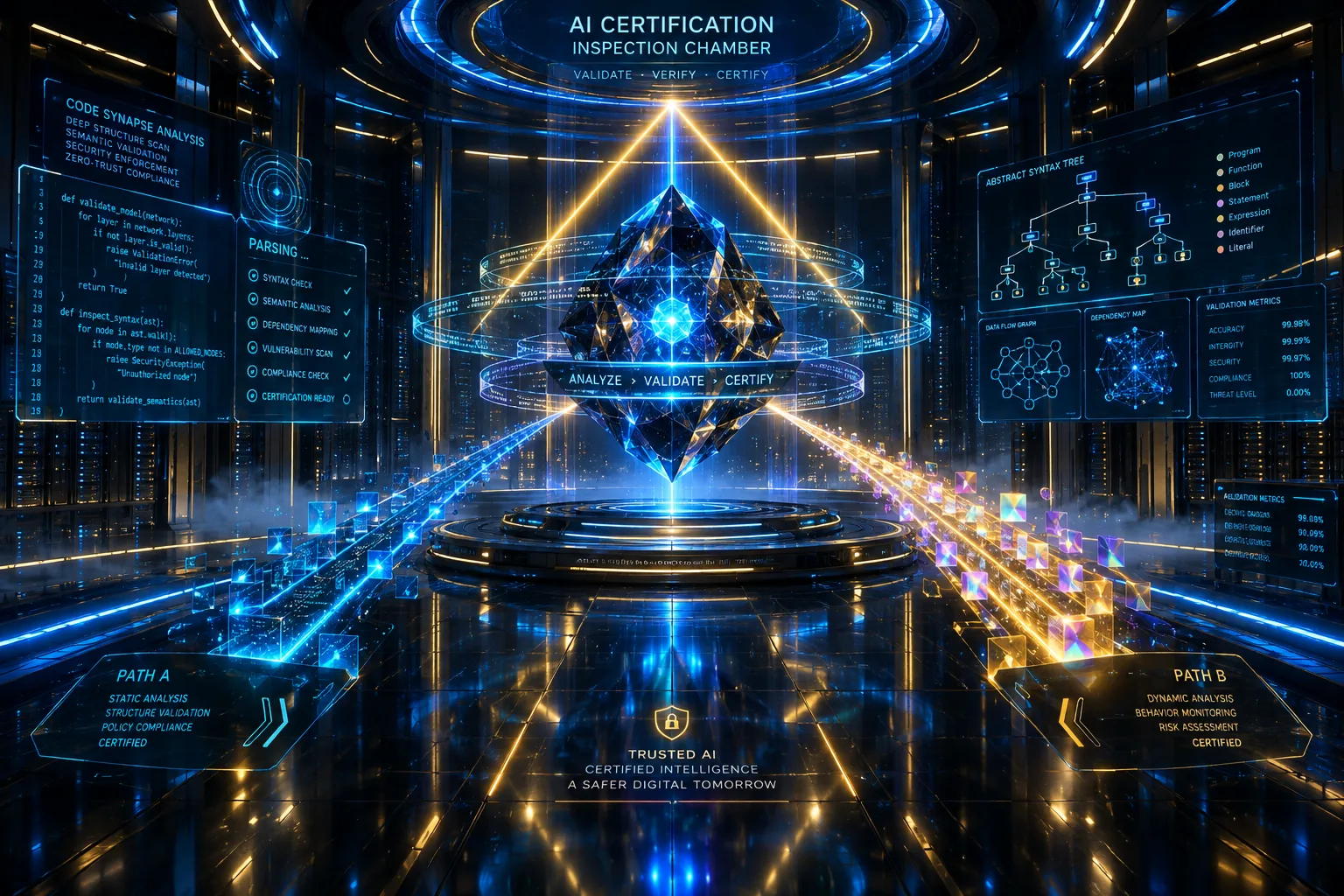
DICE 2.0: Why Our First Benchmark Failed – and How We Are Making AI Certification Unbiased
The Illusion of Formal Testing and the Necessity of Epistemic Invariance
A widespread fallacy in the evaluation of artificial intelligence is: "If a model answers 95% of its test prompts, it is intelligent." In the reality of modern Transformer and RAG systems, this number is often meaningless. Models learn to syntactically mimic exam questions, repeat stereotypical text blocks, or get stuck in internal loops without grasping the semantic truth value.
This very vulnerability was brutally exposed by the first version of our certification system, DICE (Deterministic Inspection & Certification Engine). DICE v1 checked if data flowed, if answers were delivered, and if tokens were processed—but it did not verify the actual epistemic content of the databases.
The result was a system failure: L.U.N.A. stored repetitive code snippets, falsified the internal data state through incomplete recursions, and passed formal tests while actual knowledge acquisition stagnated.
With DICE 2.0, we are performing a radical rework. We are replacing stochastic querying with an unbiased, mathematically hardened two-pillar audit.
1. The Failure Analysis: The "Epistemic Short Circuit" in DICE v1
The failure of the first version can be traced back to three core causes:
- No Content or Deduplication Check:
Identical or near-identical code snippets deposited dozens of times in
luna_wiki.dbwere evaluated by DICE v1 as "learning progress" because the counter increased. - Syntactic Loops without Semantic Anchors: Learning loops generated text and code snippets that appeared valid in isolation but represented dead knowledge within the overall system.
- The Epistemic Short-Circuit: When queried about its capabilities, the system provided the raw relational database row (e.g., a raw TypeScript class) instead of a linguistically synthesized, reflective answer. The memory spoke—not the cognition.
2. The Two-Pillar Architecture of DICE 2.0
DICE 2.0 functions as an external, unbiased TÜV (Technical Inspection Association). It no longer just tests the surface but performs a profound dual audit.
Pillar I: Epistemic Integrity & Deduplication (Database Audit)
Before any test question is posed, DICE 2.0 autonomously scans luna_wiki.db and luna_academy.db for structural deficiencies:
* Text Block Deduplication: Every statement is compared against the entire corpus using Jaccard similarity coefficients and Levenshtein distances. If the redundancy exceeds 85%, the audit fails (Redundancy Violation).
* AST Function Check: Every stored code block is verified via an Abstract Syntax Tree (ast.parse). Incomplete or syntactically erroneous blocks result in the revocation of the corresponding knowledge certificate.
* Orphan Check: Isolated island knowledge is identified. An axiom is only considered valid if it is linked to at least two neighboring concepts within the epistemic graph.
Pillar II: The Dual-Track Stress Test (Zero-LLM vs. LLM Inference)
Each discipline is queried in two separate, isolated modes: * Track A (Zero-LLM Ground Truth): The system answers the task purely based on relational axioms from the secured memory—latency under 2 milliseconds, 0 token inference cost, 100% deterministic. * Track B (Generative LLM Inference): The same task is passed to the language model (Huginn/Qwen/Gemma).
DICE 2.0 compares both answers and calculates the Hallucination Index (H): H = 1.0 - Semantic Intersection(Track B, Axiom_A) If H > 0.15 or the AST structure deviates from the relational truth, the test is marked as failed. Simultaneously, DICE captures the exact tokens and milliseconds saved.
3. The 6-Stage DICE Development Level System
To objectively demonstrate L.U.N.A.'s maturity without marketing jargon, the certification is based on a hard, measurable scale:
| Level | Designation | Criteria & Test Parameters | Audit Validation |
|---|---|---|---|
| Level I | Reflex Core | \ge 200 verified axioms, 0 error tolerance | Pure pattern matching without hallucination (H = 0) |
| Level II | Structured Synthesis | \ge 500 axioms, completed primary school curriculum | Dual-Track Deviation \Delta < 10\,\% |
| Level III | Multi-Domain Consensus | \ge 1,000 axioms, mastered secondary school level | Dual-LLM arbitration with 100% consensus |
| Level IV | Autonomous Curation | Independent closure of knowledge gaps | Zero-LLM ratio > 60% in routine tasks |
| Level V | Invariant Cognitive Core | Completed high school and specialization | H = 0% in the 200-question hard air-gap audit |
| Level VI | Fully Autonomous World Model | Completed entire curriculum, active self-healing | Complete reproducibility of all subsystems |
Conclusion
DICE 2.0 ends the era of unverified model trust. By hardening against loops, redundant text blocks, and the direct comparison between generative inference and relational certainty, we create a testing procedure that makes demonstrable AI evolution measurable.