
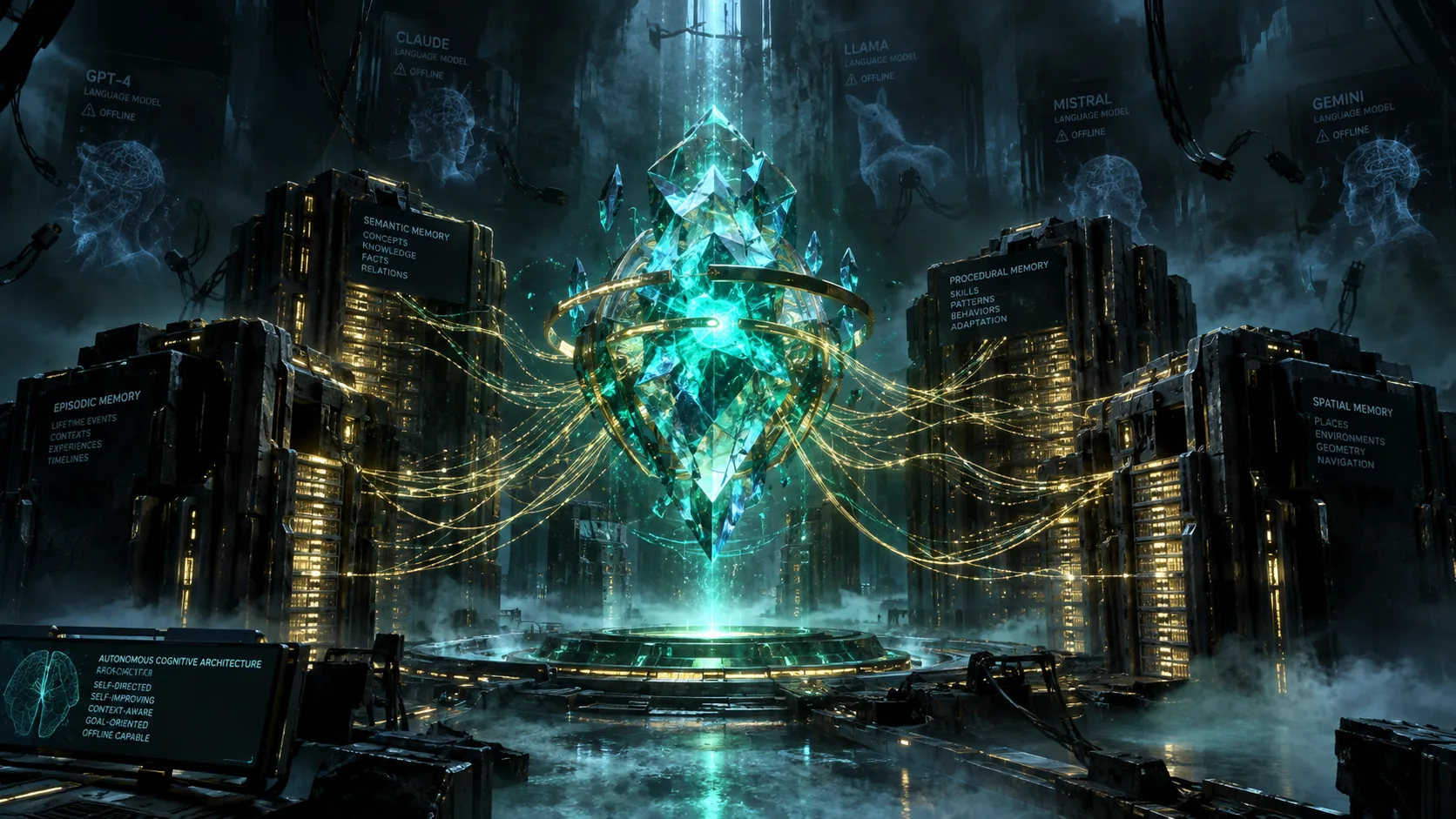
1. The Fundamental Problem of Modern AI Systems: The Parrot Trap
Nearly every system currently labeled as "autonomous AI" suffers from the same fundamental design flaw: at its core, it is merely a thin wrapper around a Large Language Model (LLM).
If such a system is given an identity, that identity collapses at the slightest inattention. It repeats the pre-filtered standard phrases of the training corpus, denies capabilities beyond its own system, or simply attempts to predict statistical word probabilities. If the inference hardware fails or a task hits context boundaries, the entire application halts. The system truly "knows" nothing—it is merely parroting.
For the architecture of our local cognitive core system, L.U.N.A., a different paradigm was adopted from the outset:
A language model is not a thinking consciousness. It is a library. L.U.N.A. uses external inference merely as a reference tool—its actual knowledge, its identity, and its judgment capabilities must exist persistently and independently within the local system core.
To not only postulate this separation theoretically but to prove it empirically, we have developed a closed verification procedure.
2. The Architecture: Knowledge Assimilation Instead of Mere Text Extraction
True cognitive autonomy does not arise from a model passing text segments along unchanged. It arises from a three-stage, recursive knowledge acquisition process:
The Three Phases in Detail:
-
Knowledge Recall Before Inference (Zero-Inference-First): When a request arrives, the system first searches its own persistent knowledge network. If the concept already exists as a verified axiom, the response is generated immediately from the local database. Not a single token is generated on the processing unit; the response time is in the single-digit millisecond range.
-
Consultation of the Reference Work: Only when the internal memory reports a valid knowledge deficit is the inference engine consulted in the background. However, it is not given a creative dialogue task but the strict mandate to deliver compressed raw facts.
-
Comprehension, Rephrasing & Assimilation: The system does not accept the delivered text as the final answer. It deconstructs the information, reformulates it in its own diegetic system voice, and writes the essence as a new, permanent axiom into its own database. For future queries on the same topic, the inference engine becomes redundant—the knowledge has been assimilated.
3. The Experiment: The "Cold Recall" Proof
To scientifically demonstrate that learned knowledge has been truly internalized and is not based on pre-trained model knowledge, the neologism experiment was conducted using an isolated stress test:
- The Test Object (
KVDK-42): A freely invented technical concept (Cryo-Vector Dispersion Condenser for Phase Stabilization) that could not exist in the training dataset of any existing language model. - Phase A (Knowledge Acquisition): The raw definition was isolatedly stored in the system. L.U.N.A. deduced the relationships, processed them in its own tonality, and saved the verified axiom in the local database.
- Phase B (The Stress Test – Complete Inference Blockade): The system initiated an automated benchmark. The entire inference service was stopped, the interfaces were locked, and the memory of the processing unit was completely cleared. The language model was demonstrably offline and unresponsive.
The Actual Measurement Result from the Test Log
The benchmark specifically evaluated two scenarios: a neologism concept previously researched and assimilated by the system (KVDK-42) versus two control terms that were completely unknown to the system (Concept_B, Concept_C):
[BENCHMARK EXPERIMENT STARTED]
Initializing test setup: Inference engine is detached and interface is locked...

[INFERENCE ENGINE OFFLINE - PROCESSING UNIT UNLOADED]
0 MB VRAM usage. Testing system retrieval purely from local knowledge base...

[BENCHMARK RESULT: ZERO-INFERENCE RECALL]
> Autonomous Hit Rate: 33.3% (1/3)
> Inference Status During Test: COMPLETELY BLOCKED
[SUCCESS] KVDK-42 (1.90 ms): KVDK-42 stabilizes quantum fluctuations of cryogenic energy to secure system barriers... -> Status: Successfully reproduced from previously assimilated axiom (Zero-GPU).
[MISSING] Concept_B (5.13 ms): Not found in the knowledge network. -> Status: Correctly rejected; the concept has not been researched previously.
[MISSING] Concept_C (1.48 ms): Not found in the knowledge network. -> Status: Correctly rejected; the concept has not been researched previously. ```
4. Conclusion
The result proves the successful paradigm shift and clearly differentiates itself from simple prompt caching:
- True Independence: Although the concept
KVDK-42was researched by the language model in the preceding learning step, it was subsequently condensed independently and permanently anchored in the local knowledge base. During the actual test, the inference hardware was demonstrably offline (0 MB VRAM) – the reproduction occurred in 1.9 milliseconds without a single GPU token. - No Hallucination, No Pseudo-Knowledge: The two control terms were not guessed or erroneously supplemented but were honestly declared as unknown.
This proves: The language model does not serve as a permanent thinking crutch for L.U.N.A., but rather as a temporary research tool. Once understood, subjects are permanently transferred to its own, hardware-independent knowledge stock.