
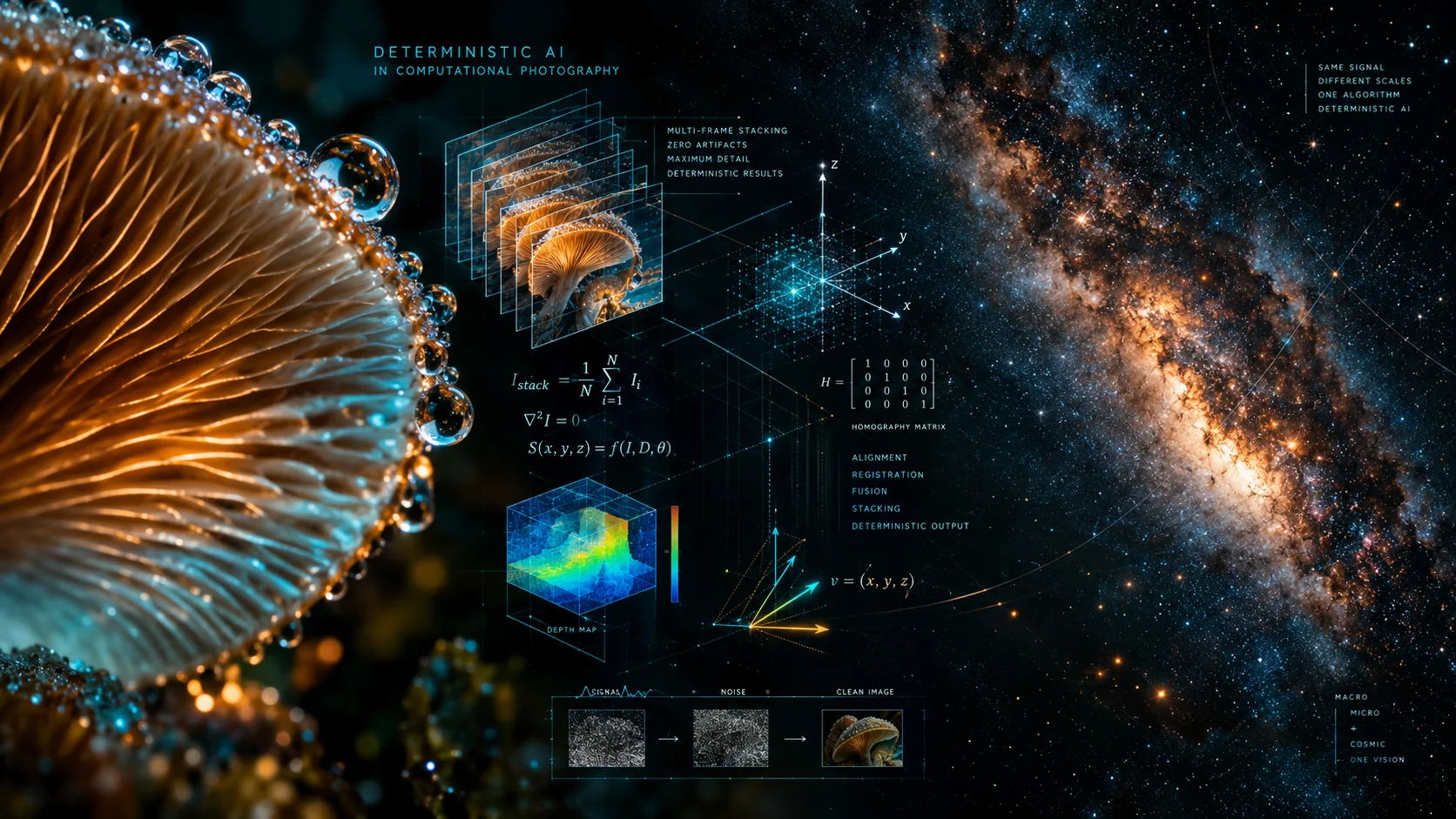
The Origin of L.U.N.A.: Why Deterministic Cognition Revolutionizes Image Stacking
1. The Genesis: Before the LLM Hype, There Was the Signal
In the current technological landscape, artificial intelligence is almost reflexively equated with chatbots, prompt engineering, and large language models. Few question that the actual origin of the L.U.N.A. (Logic & Unified Neural Architecture) project lay in a completely different, physically hard problem domain: high-precision signal processing and multi-modal stacking within the MoonEngine.
Anyone involved in demanding stacking—whether in Astrophotography, extreme focus stacking in microscopy, HDR landscapes, or high-dynamic total solar eclipse sequences—is familiar with the methodological pitfalls: * Macro & Focus Series: Microscopic focus shifts alter the magnification scale (Focus Breathing), generating torn edges, tiling artifacts, and unsightly diffraction halos at transitions. * Astro & Deep Sky: Thousands of individual exposures contend with atmospheric turbulence (Seeing), periodic tracking errors, and noise. * Landscape & SoFi: Static foregrounds must be masked bit-perfectly against drifting backgrounds without leaving ghosting artifacts. * Memory Load: Image stacks composed of uncompressed 16-bit RAW files overwhelm RAM within seconds.
L.U.N.A.'s original development approach was therefore never to build another language model. The vision was an autonomous, high-precision co-processor that understands the optical data stream, causally detects procedural errors, and synthesizes raw signals into a perfect master image with mathematical exactitude.
2. The Paradox of Generative AI in Image Synthesis
Many image processing tools currently attempt to run neural diffusion models or "AI sharpeners" over image stacks. For scientific photography and precise renderings, this is fatal:
- The Hallucination Problem: A generative model estimates missing pixels based on statistical probabilities. This may work in artistic illustration; however, with biological macro-structures, lunar craters, or star fields, the AI invents details that the optics never captured. The result is distorted and scientifically worthless.
- The Resource Trap: Operating a neural image model permanently binds 16 to 24 GB of VRAM. This very graphics memory, however, is urgently needed for parallel floating-point calculations and median filtering of the actual image stack.
L.U.N.A. takes the consistent opposite approach in the MoonEngine: Deterministic Causality (Level IV).
3. Deterministic Universal Stacking: 5 Concrete Advantages
Whether it's macro-stacking or the Milky Way: When L.U.N.A. computes, no stochastic estimations occur. It utilizes linear algebra, projective homography, Fourier spectral analysis, and two-dimensional gradient fields: ```python [ Raw Image Sequence (RAW / TIFF) ] │ ▼ ┌──────────────┐ │ L.U.N.A. Phase 0: Lucky & Focus Gate │ ◄── Measures Laplace Variance, SNR & Focus Drift │ Causal Selection of Sharp Image Regions │ Deterministically discards blurry outliers └──────┬───────┘ │ ▼ ┌──────────────┐ │ Phase 1: Registration & Alignment │ ◄── Affine / RANSAC Transformation │ Compensation for Focus Breathing & Earth Rotation │ 0 MB VRAM consumption on native CPU-ALU └──────┬───────┘ │ ▼ ┌──────────────┐ │ Phase 2: Bit-Accurate Synthesis │ ◄── Stripwise Median / Mosaic Stacking │ 100 % Preservation of all real Sensor Data │ Full GPU power for image stacking └──────┬───────┘ │ ▼ ┌──────────────┐ │ Phase 3: Intelligent Post-Processor │ ◄── 2D Light Pollution Gradient Subtraction, │ Halo Removal & Edge Feathering │ Selective denoising without detail loss └──────────────┘
- Zero-VRAM for Cognition (Full GPU Power for Pixels): L.U.N.A.'s cognition matrix runs natively on the CPU cores in microseconds. It occupies 0 MB VRAM. The entire 24 GB of modern GPU video memory remains 100% reserved for massive 16-bit arrays and CUDA/CuPy-accelerated operations.
- Causal Quality Gates (Lucky-Frame & Focus Peaking): Frames are evaluated based on physical parameters: Laplace edge sharpness, entropy, and Signal-to-Noise Ratio (SNR). Blurry phases within a focus series or wind-distorted astrophotos are causally discarded before contaminating the final result.
- Universal Artifact Removal (Post-Processing):
- In the Macro Domain: Fills tile gaps, smooths depth maps, and removes blur halos around complex edges using selective edge feathering.
- In the Astro Domain: Analytically models urban light domes via a 2D surface function and subtracts stray light bit-perfectly without damaging fine nebular gases.
- Dynamic Hardware Sensing: Tile sizes and thread allocations are calculated in real-time: TileSize = f(AvailableRAM, ImageDimensions, BitDepth) This prevents memory overflows (Out-of-Memory) even with gigapixel panoramas or series composed of hundreds of focus layers with absolute reliability.
- 100% Reproducibility: If the same image stack is calculated multiple times, the pipeline yields bit-identical master files. There is no stochastic drift.
4. Can a deterministic architecture learn?
It is often argued: "If a system computes purely deterministically, it is rigid and cannot learn." This is the opposite of the truth. L.U.N.A. learns—but not through uncontrolled neural weight shifts, but through empirical falsification and scientific insight:
A. Causal Feedback: The Difference Between Right and Wrong
In image stacking, quality is measurable: * Success: If the Signal-to-Noise Ratio (SNR) increases proportionally to the square root of the number of images (\sqrt{N), and the measurable edge sharpness increases, the transformation was optimal. * Failure: If contrast or sharpness decreases after alignment, an error occurred (e.g., faulty alignment due to focus breathing or insufficient control points).
B. Adaptive Parameter Tuning
L.U.N.A. compares the telemetry before and after the process. If it determines that for a specific lens, tiles of 512 × 512 pixels produce a more precise mosaic than 1024 × 1024 pixels, it deterministically adjusts its internal cognition matrix. The next stack automatically starts with this optimized experiential value.
C. Negative Sampling for Optical Error Vectors (luna_wiki.db)
If a process step is rejected (e.g., unstable mosaic due to edge artifacts), L.U.N.A. saves the event as a Negative Sample. It stores the exact cause:
"Threshold difference < 1.0 with Sharpness Score < 4.0 leads to background tiling. Deterministically raise threshold."
During the next run, this protection mechanism is already active in Phase 0—the error is never repeated.
5. The Duality: L.U.N.A. Lite & Autonomous Standalone Operation
A crucial architectural goal of the MoonEngine from the outset was commercial standalone capability. Software that requires a running AI hub, gigabytes of server backends, or cloud APIs for every calculation is impractical for real-world deployment.
Therefore, L.U.N.A. was modularly decoupled: * LunaLite (Headless Micro-Core): The MoonEngine integrates L.U.N.A.'s cognition as an autonomous module. No LLMs, no background agents (Beaker, Simon, etc.), and no inference servers are started. * No Resource Contention: L.U.N.A. Lite operates as a pure mathematical filter. Even on a laptop in the field without an internet connection, the complete cognitive stacking logic runs with 0 MB VRAM consumption. * High-Compute Lock in the Hub: If the MoonEngine is running on a workstation where the L.U.N.A. Prime Hub is active in parallel, the Engine enforces a Resource Lock upon stacking initiation. Background simulations and model queries are paused until the master TIFF is fully rendered.
6. Conclusion
L.U.N.A. was not invented at a desk to formulate texts, but in response to the harsh reality of optical sensor data.
The synthesis of the MoonEngine as a universal stacking tool and L.U.N.A. as a deterministic judgment instance proves this: True artificial intelligence does not require hallucinated pixel patterns. It requires unimpeachable mathematical causality, measurable feedback loops, and the ability to learn permanently from every physical experiment.